Originally Published by the Delmarva Parent Teacher Coalition
Guest Contributor
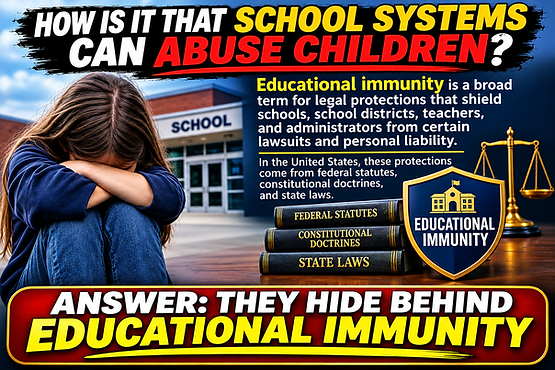
Ever wonder why things have gotten so bad in public education? Perhaps one of the biggest reasons is that there is very little meaningful accountability when school systems fail the very children they are supposed to serve.
Please follow us on Truth Social, X, YouTube, Minds, Telegram, Rumble, GETTR, Gab, Instagram
Parents can complain. Teachers can speak out. Taxpayers can demand answers. Families can even take legal action. But pursuing a school system through the courts can become an expensive, exhausting, and often unsuccessful battle. Legal protections, procedural hurdles, and the cost of litigation can make it extraordinarily difficult for families to obtain justice.
Why?
One factor is something commonly referred to as Educational Immunity: the various legal doctrines and statutory protections that can shield school districts, boards of education, administrators, and employees from certain forms of legal liability.
And here's where the accountability problem becomes even more concerning.
Who actually pays when something goes wrong?
We do.
In many situations, individual administrators are not personally responsible for the financial consequences of their decisions. Legal liability may instead fall on the school district or Board of Education, meaning the financial burden can ultimately be borne by taxpayers.
Meanwhile, the people making administrative decisions may continue working behind the scenes, while elected Board members are left to answer for problems they may not have known existed.
How does that happen?
Because Boards of Education frequently depend on administrators to provide accurate information about what is happening inside the day-to-day operations of the school system. If information is withheld, incomplete, or presented in a misleading manner, elected Board members cannot properly exercise their oversight responsibilities.
In the case where a Board learns of what their administration is doing, they either cover for them or expose them.
And when serious problems finally come to light, what happens?
Too often, the instinct of administration is to minimize the situation, protect the institution, avoid public scrutiny, and let the legal system handle the fallout.
Parents are left fighting for answers. Employees are left afraid to speak out. Taxpayers are left footing the bill.
Where is the accountability?
Educational immunity was never supposed to be a license for misconduct, negligence, or administrative incompetence. Legal protections should not become an excuse to avoid transparency or responsibility.
Public education is funded by taxpayers and entrusted with the welfare and education of children. That trust comes with an obligation to be accountable.
If administrators can make consequential decisions without meaningful personal consequences, if Boards cannot get the truth from their own administrations, and if families cannot realistically afford to pursue justice, then we have a serious accountability problem.
A school system should not be an institution where the administration protects itself, the elected Board takes the blame, the taxpayers pay the bill, and the children suffer the consequences.
It's time to start asking some uncomfortable questions about Educational Immunity and who it really protects.
Fellows & Editors
November 21, 2026 - Copyright DelmarvaPTC.org
Opinion and Contributor Content Disclaimer
From time to time, this publication publishes opinion pieces, guest columns, letters, and articles submitted by individuals and organizations outside of our editorial staff. The views, opinions, and assertions expressed in such contributions are solely those of the authors and do not necessarily reflect the views, policies, positions, or opinions of this publication, its editors, owners, staff, or affiliates.
Publication of outside submissions does not constitute endorsement of any statements, claims, conclusions, products, services, or organizations referenced therein. Responsibility for the accuracy of facts, opinions, and representations contained in contributed content rests entirely with the author(s).