
State "Star" Rating System Discounts Academic Achievement As Measure Of School Success
Every Raven fan will tell you that the team is having a pretty mediocre, even bad, season right now. They are last in their division, and the team has lost their last three games.
Imagine if the coach of the Ravens began his next press conference like this:
"We are so proud of how much everyone likes our uniforms. Our uniforms have been rated highly by our fans. In fact, the fan ratings of our uniforms are so much better than last year's ratings. Thank you! We are so proud of that fact!"
With that, the coach leaves the podium.
What would the reaction be? I'm sure you don't have to think too hard to come up with the answer to that question. Fans would be clamoring to fire the coaches, the GM, etc. No one would take his message as an accurate assessment of the team's success this year.
Please Follow us on Truth Social, X, Youtube, Minds, Telegram, Rumble, GETTR, Gab, Instagram
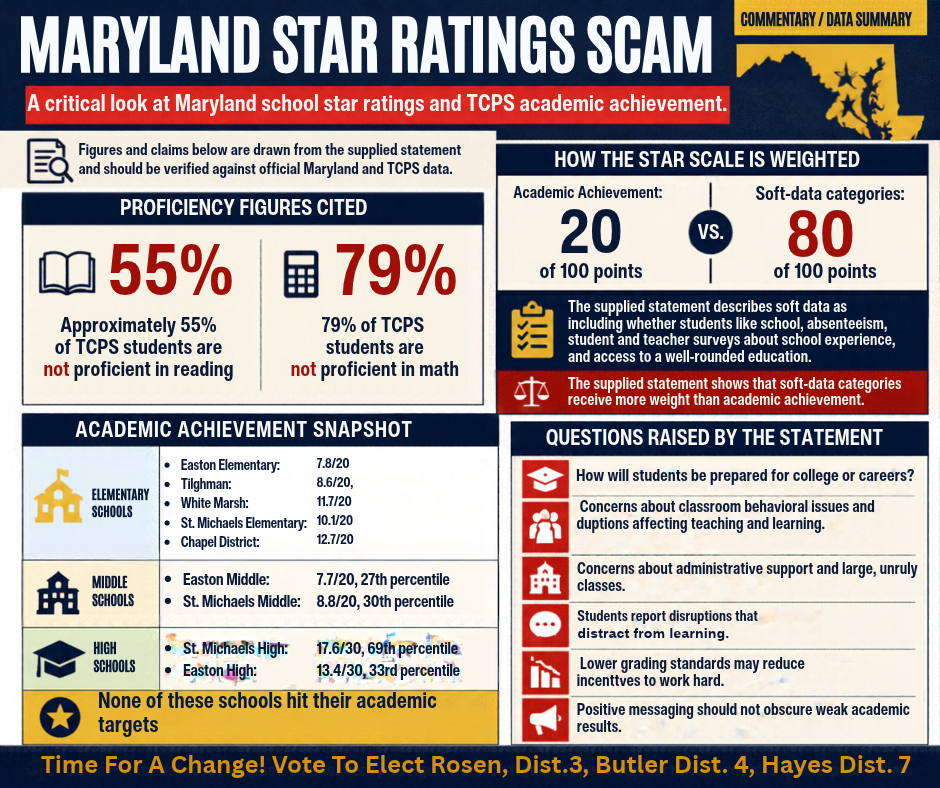
Yet, on Thursday, the Talbot Spy, published a letter from two school board candidates and present school board members Emily Jackson and Amy Dodson, bragging and celebrating about how county school star ratings, and supposedly academic achievement, have improved.
It was an attempt to polish the proverbial turd. It didn't work.
First, let us say this opinion piece has nothing to do with the teachers in the school system or the students. Talbot teachers contact us on a weekly basis to tell us that they are working very hard to educate our students but that they struggle to teach in classrooms that are crowded and disruptive, that they receive very little or no support from administrators and central office staff, and that they struggle with a confusing new grading system in the county which rewards students who do little or no work and disincentivizes excellence and hard work. They tell us no one wants to listen, including school board members or upper-level administration.
Many would leave if they could but are bound here to keep their retirement and years of experience. They would speak out more, but they are afraid of retribution.
So, what is the real picture? Let's talk about the state's star rating system.
The Star System, theoretically, is designed to give parents and community a quick graphic evaluation of the schools in their district. A school can get score out of FIVE possible stars, 5 is the best, 1 is the lowest.
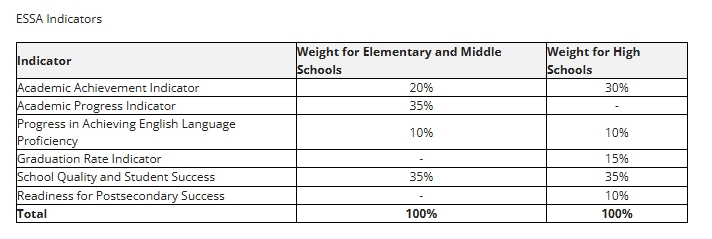
Here are the areas schools are evaluated on and their "weighting" in the system:
The Academic Achievement indicator is a component of the accountability system for elementary, middle, and high schools. This indicator describes student performance on state standardized tests in English Language Arts and math. There are four measures in this indicator: (1) percent of students scoring “proficient” or higher on state standardized math tests; (2) average Performance Level of students on state standardized math tests; (3) percent of students scoring “proficient” or higher on state standardized English Language Arts tests; (4) average Performance Level of students on state standardized English Language Arts tests.
For elementary and middle schools, the Academic Achievement indicator has a total of 20 possible points; each measure has 5 possible points. For high schools, the Academic Achievement indicator has a total of 30 possible points; each measure has 7.5 possible points.
The Academic Progress indicator is a component of the accountability system for elementary and middle schools. For elementary schools, the Academic Progress indicator has four measures: (1) student growth on state standardized math tests; (2) student growth on state standardized English Language Arts tests; (3) percent of students scoring “proficient” or higher on the state science test; (4) percent of fifth graders earning credit in social studies, fine arts, physical education, and health courses. The Academic Progress indicator for elementary schools has 35 possible points: 25 possible points for student growth (12.5 for English Language Arts and 12.5 for math), 5 possible points for science proficiency, and 5 possible points for the percent of fifth graders earning credit in social studies, fine arts, physical education, and health.
The Academic Progress indicator for middle schools has five measures: (1) student growth on state standardized math tests; (2) student growth on state standardized English Language Arts tests; (3) percent of students scoring “proficient” or higher on the state science test; (4) percent of students scoring “proficient” or higher on the state social studies test; (5) percent of eighth graders earning credit in English Language Arts, math, social studies, and science courses. The Academic Progress indicator for middle schools has 35 possible points: 25 possible points for student growth (12.5 for English Language Arts and 12.5 for math), 3.5 possible points for science proficiency, 3.5 possible points for social studies proficiency, and 3 possible points for the eighth graders earning credit in English Language Arts, math, social studies, and science courses.
Don't be fooled into thinking this category has anything to do with actual academics. The State doesn't define how much progress earns each school specific points, leaving the measure open to subjective interpretation. They don't even have a progress indicator for high schools.
The Graduation Rate indicator in Maryland’s accountability system is designed for high schools only. The indicator includes one measure, the graduation composite, and two components: the 4-year adjusted cohort graduation rate and the 5-year adjusted cohort graduation rate. For the school report cards and accountability system, cohort graduation rates are lagged by one year. For example, for the 2022-2023 Accountability reporting, the 2019 first-time 9th-grade students formed the adjusted cohort for the four-year and five-year graduation rates. This means that the 2021-2022 4-year and 5-year adjusted cohort graduation rates are reported.
The Graduation Rate indicator has 15 possible points: the 4-year adjusted cohort graduation rate has 10 possible points and the 5-year adjusted cohort graduation rate has 5 possible points.
This is an indicator that school systems can control themselves since they are the ones who award diplomas and who can do whatever they can to get students to graduate even if those students aren't academically ready. How many students do they graduate who can't read or do math?
The School Quality and Student Success (SQSS) indicator in Maryland’s accountability system has 35 possible points and includes three measures: chronic absenteeism (the percentage of students not chronically absent) (15 possible points), scores on the Maryland School Survey for students and educators (10 possible points), and access to a well-rounded education (10 possible points).
This category is based on the Maryland School Survey, a survey administered to students in grades 5-11 and each school’s instructional staff (educators). The survey measures four school-related domains: safety, environment, community, and relationships. Each domain is made up of groups of questions, called topics. The survey for educators contains an additional topic on the quality of instructional feedback.
The school survey is a component of the School Quality and Student Success indicator of the accountability system for elementary, middle, and high schools (10 possible points). The student survey has seven possible points, and the educator survey has three possible points.
Among "data nerds", they call this "soft data."
Soft data refers to qualitative, descriptive, or subjective information that helps explain people's experiences, perceptions, opinions, behaviors, and attitudes. Unlike hard data, it is generally not expressed as precise numerical measurements.
Examples of soft data
- Personal observations and experiences.
- Interviews and conversations.
- Opinions and perceptions.
- Anecdotal reports.
- Student, parent, and staff feedback.
- Community concerns and testimonials.
- Classroom observations.
- Descriptions of organizational culture or morale.
So, in the star system, 35 points is based on soft data. Opinions. In other words, data that can be manipulated or misinterpreted.
The Progress in Achieving English Language Proficiency indicator in Maryland’s accountability system includes one measure, the percentage of students making progress towards attaining English language proficiency as measured by growth on the English Language Proficiency Assessment (ELPA). The Progress in Achieving English Language Proficiency indicator has a total of 10 possible points.
It is not included in high school scores.
The Readiness for Postsecondary Success indicator in Maryland’s accountability system is designed for high school only. The indicator includes two measures: on-track in 9th grade and credit for completion of a well-rounded education. The Readiness for Postsecondary Success indicator has a total of 10 possible points; each measure has 5 possible points.
Again, this is a data point that is easily manipulated by systems who, with easier grading systems, can push students through courses without the student actually being competent in the course material.
And yet, Ms. Jackson and Ms. Dodson as well as system administration, are acting like they have reached the academic promised land.
So, certainly, with this fairly easy rating system, Talbot Schools scored 5 Stars across the board, right?
Not so fast.
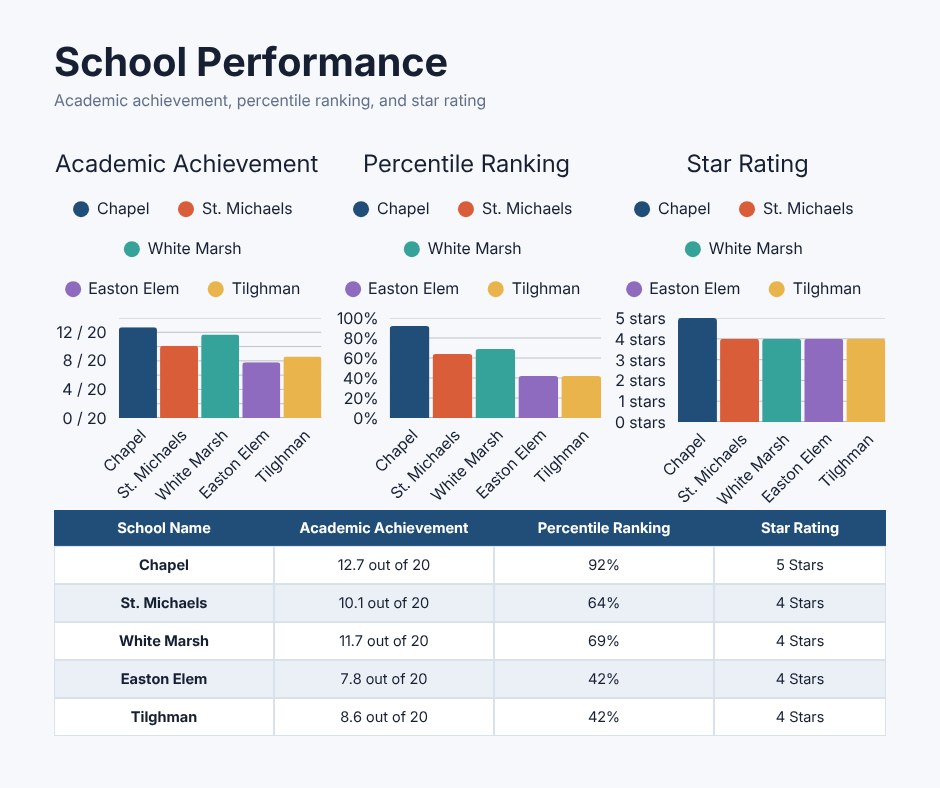
Here are the academic achievement scores, school percentile rankings in the state, and star ratings for each school:
ELEMENTARY SCHOOLS:
Is anyone else wondering how a school could get five or four stars with an academic performance score that is weak? Even the top school, Chapel, only got 64% of the points in that category. By most grading systems, that's a "D." No offense to Chapel, but that is not a good score.
Also, not one of these schools hit their academic achievement targets.
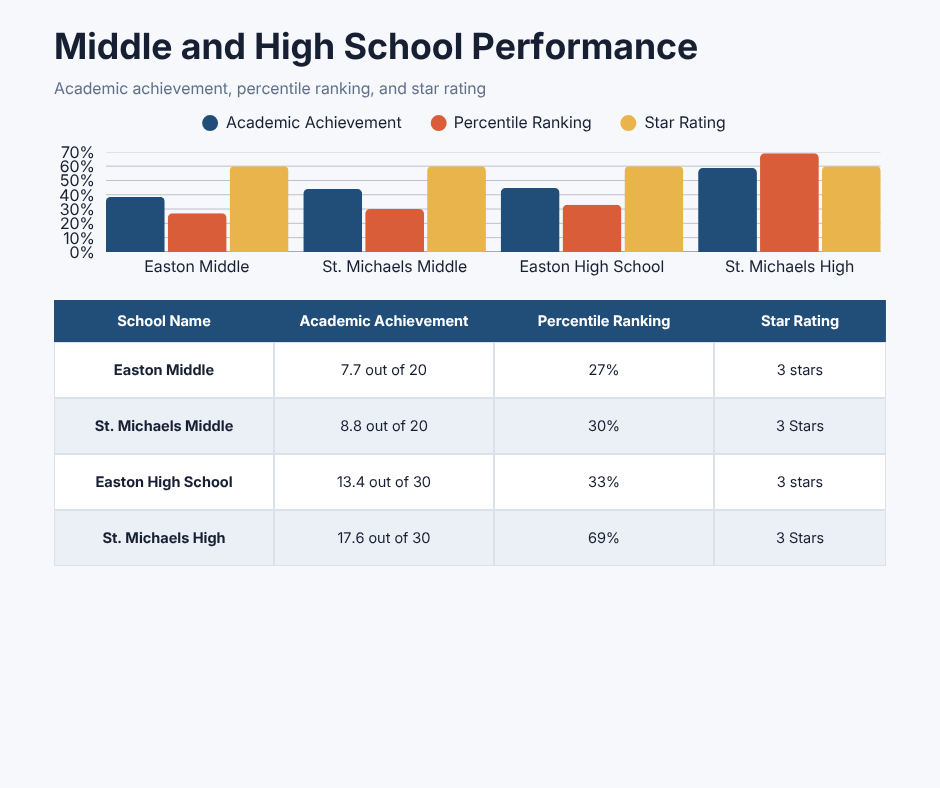
As for the Middle and High School ratings, it is disturbing that all four of Talbot's secondary schools only managed 3 stars out of 5. The academic achievement scores at these schools topped out at 44% of the total points in the category for middle and 59% for high school. None of the schools got a passing grade in academic achievement. None of these schools met their achievement targets either.
As a former district Local Accountability Coordinator, I understand how frustrating it is to report scores that are weak and not what the public expects. However, when the Board of Education President Emily Jackson and Vice President Amy Dodson are willing to spin the scores in order to be re-elected, that is troubling.
I also understand that the State of Maryland is under severe criticism of the Blueprint for Maryland's Future excessive and county crippling spending, has to make it seem like the Blueprint is working when it is not. State Superintendent Carey Wright and Vice President of the State School Board James Bell, when asked by reporter Chris Papst, about meeting score goals, were not worried:
Maryland schools spend billions more, miss academic goals, education leaders not concerned
Here's a recap of what Wright said when asked about not meeting goals: (From WBFF)
“I'm not the least bit concerned about that,” said Wright.
“Why set goals then?” Papst asked.
“Well, you set a goal for everything in life,” Wright responded. “It guides your work and it focuses your attention. If we were setting a goal and consistently not meeting it, that's on us then to reexamine the why. Why are we not meeting it.”
“You're not meeting the goals,” said Papst.
“Right,” agreed Wright.
“I am kind of confused. Why set a goal if you're saying that not meeting it is not a big deal?” Asked Papst.
“So, if you are setting a goal personally and you didn't meet it, wouldn't you want to ask yourself why did I not meet that goal?” Wright countered.
“I think that’s what I'm asking you,” Papst replied.
“We set goals to make sure that we're making sure that we, our kids are moving toward those goals,” Wright responded. “It's the way I've done my entire career. You’ve got to set a goal because otherwise you have no idea where you're headed and you have no idea if you're going to get there or not. If you don't have a goal in life.”
Huh?
Change and improvement only occur when true leaders tell the truth and spread a message of doing what is needed to make things better. It's clear that the Talbot County Public Schools are stagnating in a position of mediocrity with the rest of the State of Maryland and no one in the administration seems concerned. They keep going out and spreading a message which reminds us of the story, "The Emperor Has No Clothes." The emperor was naked, but his court pretended that he was wearing the most beautiful clothes and spread the delusion until all believed it except one small child who called out the lie. Then, and only then, did the people see the truth.
Now it's time for Talbot County to wake up and see the truth. One of these board members has had 8 years to make things better. That should be enough.
Change is desperately needed.
That is why the EASTON GAZETTE endorses School Board candidates Anne Rosen, District 3, Mike Butler, District 4, and Lisa Hayes, District 7.