By Contributor Karen Wayland
A couple of weeks ago, the following agenda from the "Technical Advisory Committee" caused quite a stir among residents up and down Oxford Road:
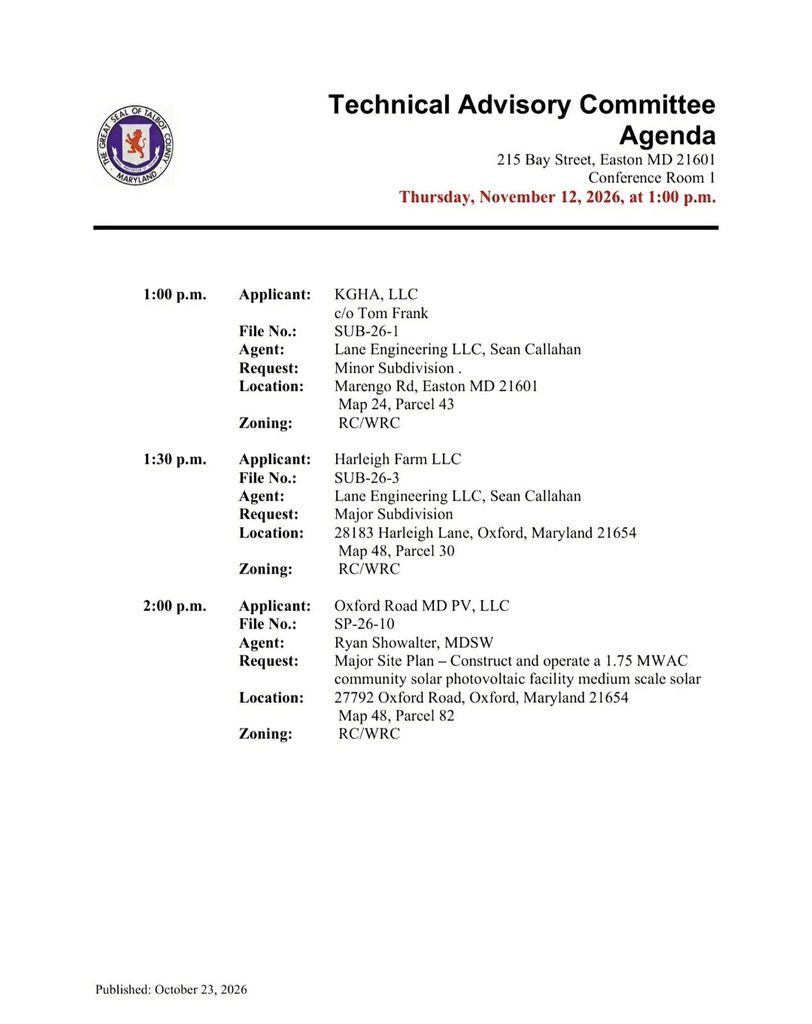
The third item on the agenda was the one that caused the most concern. It is for a "1.75 MWAC community solar photovoltaic facility" at 27792 Oxford Road, Oxford, Maryland. Many residents have seen the sign posted regarding the planned facility.
Please follow us on Truth Social, X, YouTube, Minds, Telegram, Rumble, GETTR, Gab, Instagram
One Oxford resident, Karen Wayland, posted the following on social media. Karen has been a great resource for information on other issues affecting Oxford, including what could happen with the Robert Morris Inn. We thank her for her contribution.
I've spent the better part of two nights and now this morning researching the proposed community solar project on Oxford Road and the questions residents have raised. Full disclosure, I've spent the last two decades working on clean energy policy, so I strongly support solar in the right places. I have been working on electric grid issues specifically for the better part of the last 15 years. Before that I worked on land use, water quality and watershed management, conducting my Ph.D. research on stormwater runoff from agricultural and urban watersheds and how forested riparian areas and constructed wetlands can protect waterways. I currently serve as the chair of the Board of Maryland's green bank, the Maryland Clean Energy Center, which finances solar projects. I have don't know the property owner or developers and I have no financial interest in this project.
So while my friend Claude helped me with pulling this fact sheet together, none of the information was new to me, and I edited it to add additional information. Hopefully this will touch on key questions--what is community solar, who will buy the power, what laws govern the approval process and what role the state and county play, what will happen to the farmland during and after development, how can the developer minimize environmental impacts, how can we protect the unique Oxford Road viewshed, what grid equipment will be necessary onsite and on the Oxford Road distribution line, and what will happen when the project reaches its end of life.
Happy to chat with anyone about this document. It may not change your mind about solar in general or this project specifically, but I hope it clears up some of the questions that are swirling around the project. The fact that no one could answer some of these pretty basic questions at a public meeting for legitimately concerned residents is a shame.
We asked Karen if we could post the information and she graciously gave us her approval. Here is the fact sheet she provided:
Compiled by Karen Wayland, current as of November 14, 2026
A 1.75 MW community solar project is proposed at 27792 Oxford Road (County file SP-26-10). Here is what County and State law require of it, and what I’ve learned about the questions neighbors are raising.
Maryland community solar program
What is community solar? A shared solar project that Maryland electric customers can subscribe to without putting panels on their own property. Maryland created a pilot program in 2015. In 2023 the General Assembly made it permanent with House Bill 908 (Chapter 652 of 2023), which took effect July 1, 2023. The Public Service Commission runs the program under Public Utilities Article § 7-306.2 and adopted the permanent program’s rules effective January 1, 2025.
What are Maryland’s ground rules? Under state law, each community solar project:
• Is limited to 5 MW, measured by its inverters’ AC rating. There is no statewide cap on total program capacity.
• Must be in the same utility service territory as its subscribers.
• Must deliver at least 40% of its electricity to low- and moderate-income subscribers, unless the project is wholly owned by its subscribers or a nonprofit.
• Generally cannot sit on the same or an adjacent property as another community solar project owned by the same company, with limited exceptions.
Who buys the power? Delmarva Power customers in Maryland who subscribe to a share of the project’s output. Households, renters, businesses and other customer classes can all take part. It doesn’t matter whether a customer buys electricity from Delmarva’s standard offer service or from a retail supplier.
How do subscribers benefit? Each subscriber gets a credit on their Delmarva bill for their share of the electricity the project produces. Under the permanent program, the subscription charge can appear on the Delmarva bill itself (“consolidated billing”), so subscribers don’t get a second bill. Terms for most subscribers depend on their contract.
What protections do lower-income households get? Maryland law guarantees them real savings. A low- or moderate-income subscriber cannot be charged more than 90% of the value of their bill credit, so they save at least 10%. Under the 2023 law, a household qualifies as low-income at or below 200% of the federal poverty level, or as moderate-income at or below 80% of Maryland’s median income. Households in certain designated overburdened and underserved census tracts also qualify.
Where does the electricity actually go? Onto Delmarva’s local distribution line along Oxford Road. In practice it is used by the nearest homes and businesses on that circuit, in and around Oxford. Subscribers elsewhere in Delmarva’s Maryland territory get bill credits, but the electricity itself is used locally.
What if not every share is sold? Under a 2025 state law, credits for unsubscribed power are banked for up to a year so they can be passed on to subscribers later.
Can I sign up? If you are a Delmarva customer in Maryland, generally yes, once the project is built and enrolling subscribers. Subscriptions can move with you if you relocate within Delmarva’s Maryland territory. The Public Service Commission’s community solar page explains how to subscribe and how to verify income eligibility.
The project and how it gets approved
What is proposed? Oxford Road MD PV, LLC proposes a 1.75 MW (AC) community solar facility at 27792 Oxford Road. The acreage will be shown on the site plan. The site is zoned RC/WRC (Rural Conservation/Western Rural Conservation) and lies in the Critical Area.
Who decides? Talbot County, not the State. Projects over 2 MW need a state certificate from the Public Service Commission; at 1.75 MW, this one is below that line. The County Planning Commission makes the final decision on the major site plan, after review by county staff. The Critical Area Commission also reviews it.
Can the County say no? Only if the plan fails to meet the rules. Under the Renewable Energy Certainty Act of 2025, a county may not prohibit solar or deny a site plan that meets all applicable requirements, and community solar up to 5 MW is processed as a permitted use. Talbot’s own code already treats a project this size as medium-scale solar, allowed with a site plan and a landscaping and screening plan.
What does that mean for neighbors? The useful question is not whether, but how well, this project should proceed. Comments that ask for specific improvements, such as better screening, carry real weight.
Are we losing farmland? A little, and only for a while. Talbot County had 96,228 acres in farms in 2022, up 3% from 2017. Even 10 acres would be about 0.01% of that. State law bars topsoil removal and requires minimal grading, and the owner must remove the facility at the end of its life, so the field can go back to crops. Houses, by contrast, take farmland out of production for good.
Can it be built so the land comes back as farmland? Yes, and neighbors can ask the County to make these practices conditions of approval:
• Driven or screw piles instead of concrete footings for the panel racks, so supports pull out cleanly at the end.
• Concrete only where needed, such as small pads for inverters and the transformer, removed at decommissioning.
• Gravel access roads kept to a minimum, laid over geotextile fabric so the gravel can be lifted off.
• Cable trenches backfilled in soil order, subsoil first and topsoil last, or cables run above ground on the racking.
• Existing drainage tile and ditches mapped and protected,with any damage repaired.
• Ground cover seeded promptly with native grasses or pollinator plants to hold soil during and after construction.
• Soil restoration in the decommissioning plan, including breaking up compacted soil and replacing topsoil, so the field is ready to farm again.
Will it hurt the soil? State law is written to prevent that. It requires minimal grading, no topsoil removal, limited mowing, and no herbicides except for invasive species. Land kept under cover rather than tilled each year tends to gain organic matter rather than lose it.
Do the panels leach toxic chemicals? The standard panels are crystalline silicon: about 90% glass, polymer and aluminum by weight, with trace metals that generally test below federal toxicity limits. Lead, from solder, is under 0.1% of a panel and is being phased out. Retired panels are not classified as hazardous waste under federal law.
What about the Bay? The state rules on grading, topsoil, mowing and herbicides limit runoff from the site, and land that is not tilled and fertilized each season generally sends less nitrogen and phosphorus toward the creek than row crops. The Critical Area Commission also reviews the project under its own solar rules, including limits on clearing forest and a required planting plan.
What are the real runoff risks, and how are they handled?The risks are real but manageable, and they come mostly from construction and from poor ground cover, not from the panels themselves:
• Bare soil during construction. Clearing, grading and trenching can wash sediment into ditches and the creek before ground cover grows in.
• Drip lines. Rain sheds off the lower edge of each panel row in a line. On bare or compacted ground, that concentrated flow can cut small channels.
• Compacted soil. Heavy equipment can compact the field so it absorbs less water.
• Roads and pads. Gravel roads and equipment pads shed more water than the field around them.
Maryland law already requires a stormwater plan. Under MDE’s guidance for solar, any project disturbing more than 5,000 square feet must address stormwater, typically by directing runoff from each row of panels over the vegetated strip between rows. That approach generally needs runoff to sheet flow across vegetated areas, works best on slopes under 5%, and needs a vegetated strip at least as wide as the panel row above it. This field is very flat, which is the best case for that approach: water spreads out and soaks in instead of running off in channels.
Neighbors can ask the County to make sure the plan does the following:
• Phase the work and stabilize fast. Silt fence and other erosion controls go in before any grading, and disturbed ground is seeded or mulched promptly.
• Establish dense, deep-rooted ground cover under and between the rows, with inspections and reseeding of bare spots until it is fully grown in.
• Protect the drip lines with dense vegetation or a stone strip where water falls off the panels, so flow stays spread out.
• Avoid and repair compaction, using lighter equipment and breaking up compacted soil before seeding.
• Plant a riparian buffer of native trees and shrubs between the array and any stream, ditch or shoreline, wider than the 100-foot Critical Area minimum where there is room. A forested buffer filters runoff, shades the water and gives wildlife a corridor.
• Keep panels, roads and equipment out of the buffer,wetlands and drainage ways, and protect existing ditches and drainage tile.
• Inspect after storms for erosion during the first growing seasons, with the County able to require repairs.
Heat, property values and the view
Will it create a heat island? Not one neighbors would notice. The study behind this concern was done in the Arizona desert and found arrays 3–4°C warmer at night, but the lead researcher reported the warming fades within about 30 meters. An 18-month study at a large North American solar farm found the array usually cooled completely at night, with air within 0.3°C of normal about 300 meters out. State law requires panels to be at least 150 feet (about 45 meters) from any home, and the same researchers found that vegetation under panels lowers temperatures.
Will it lower property values? The best evidence says the effect is small and close-in. A Lawrence Berkeley National Lab study of 1.8 million home sales near 1,500 solar projects found about a 1.5% average reduction within a half mile and no measurable effect beyond a mile. Other studies, in the Midwest and Indiana, found no negative effect at all. The LBNL study did not account for setbacks or landscaping, both of which state law now requires.
What will we see from Oxford Road? Talbot County requires a landscaping and screening plan for a project this size. State law requires landscape buffers or vegetative screening, an average panel height of 15 feet or less, no lighting from dawn to dusk, and a five-year landscaping bond that is released only when plantings survive. Because Oxford Road is part of the Chesapeake Country Scenic Byway, neighbors can reasonably ask the County for screening along the sides of the site as well, so the array isn’t visible at an angle as drivers approach.
Isn’t any power plant better than solar on farmland? Every way of making electricity uses land and changes a view; the question is how much, and for how long. A gas plant packs a lot of power onto a small plant site, but it brings infrastructure that a project like this one does not:
• Pipelines. Gas has to be piped in. According to FERC, a gas pipeline right-of-way is generally 75 to 100 feet wide during construction, and the permanent right-of-way is usually about 50 feet wide, kept clear for the life of the line.
• Transmission lines. A large plant connects to the high-voltage grid. Typical structures run 60–90 feet tall for 230 kV H-frame lines and 90–150 feet for 500 kV towers, on rights-of-way 100 to 200 feet wide.
• The plant itself. Stacks, buildings and lighting that operate around the clock.
By comparison, this project’s panels must average 15 feet or less, it connects to the local distribution line rather than the high-voltage grid, it must be screened, and the owner must remove it and post a bond to cover the cost. A pipeline easement and a transmission corridor are generally permanent.
A local example: the Vienna plant on Route 50. Drivers between Easton and Salisbury pass the Vienna Generating Station on the Nanticoke River, a 167 MW oil-fired plant owned by NRG that has operated since 1968. It runs less than 2% of the year, only at times of peak demand. The transmission line leaving the Vienna substation runs on a cleared right-of-way 150 to 300 feet wide, with structures 100 to 130 feet tall; the towers carrying it across the Nanticoke were 220 feet tall and are being replaced with 259-foot structures. Those towers are visible for miles across the river. The Oxford Road project’s panels must average 15 feet or less and sit behind a planted screen.
Will it need big new power lines? A project this size is governed by Maryland’s small generator interconnection rules (COMAR 20.50.09), which cover connections to the utility’s local distribution system, not the high-voltage transmission grid. Delmarva must study the connection and identify any upgrades it needs; the study results will show exactly what is required at this site. Maryland uses a “causer pays” rule, so the developer, not Delmarva’s customers, pays for any upgrades the connection needs.
What equipment does a project this size typically need? The interconnection study for this site is not public, so the list below is what Delmarva and Maryland rules typically require for a distribution-connected solar project of about 2 MW. The study will confirm the specifics.
On the site (owned by the developer):
• Inverters that convert the panels’ DC power to AC. Maryland requires “smart” inverters that help hold voltage steady on the line.
• A pad-mounted step-up transformer, about the size of a large utility cabinet, that raises the inverter output to the line’s distribution voltage. It sits on a small concrete pad.See photo of pad-mounted transformer for solar here.
• A disconnect switch that lets utility crews isolate the facility. Maryland rules require it to be installed, owned and maintained by the project owner, between the facility and the point of interconnection.
• Underground or overhead wiring from the transformer to the property edge, plus a security fence around the equipment.
Depending on the technology products used by the developer, the inverters, transformer and switch can sometimes be combined into one cabinet or box like this ABB product.
At the road (where the project meets Delmarva’s line):
• A short tie line, usually a few new poles or an underground run, from the site to the existing line along the road.
• A utility-operated recloser, a pole-mounted circuit breaker with relaying and communications, which can cut the project off the line automatically if there is a fault. See photos here.
• Utility-grade primary metering to measure the power the project sends onto the grid.
• Telemetry and remote trip capability so Delmarva’s control center can monitor the project and shut it off remotely.
On Delmarva’s distribution line (only if the study finds a need):
• Converting a single-phase section to three-phase or upgrading wire if the existing line can’t carry the output.Residents will not notice the difference between current wires and upgrades, if the interconnection study shows it is necessary.
• Adjusting voltage regulators, capacitors or protective settings on the feeder.
• Protection upgrades at the substation in some cases.
All of this is distribution-level equipment of the kind already found along rural roads. A project this size does not involve new transmission towers or a new substation. Under Maryland’s “causer pays” approach, the developer pays for any upgrades the study requires.
What happens to the panels after 25 or 30 years? The owner must remove them. State law requires a decommissioning agreement and a surety bond of up to 125% of the removal cost, updated every five years, so taxpayers are not left with the cleanup. Maryland does not yet require panels to be recycled, though a state working group has studied it and U.S. recycling capacity is growing. Neighbors can ask that the decommissioning plan commit to recycling. Either way, standard crystalline silicon panels are not classified as hazardous waste.
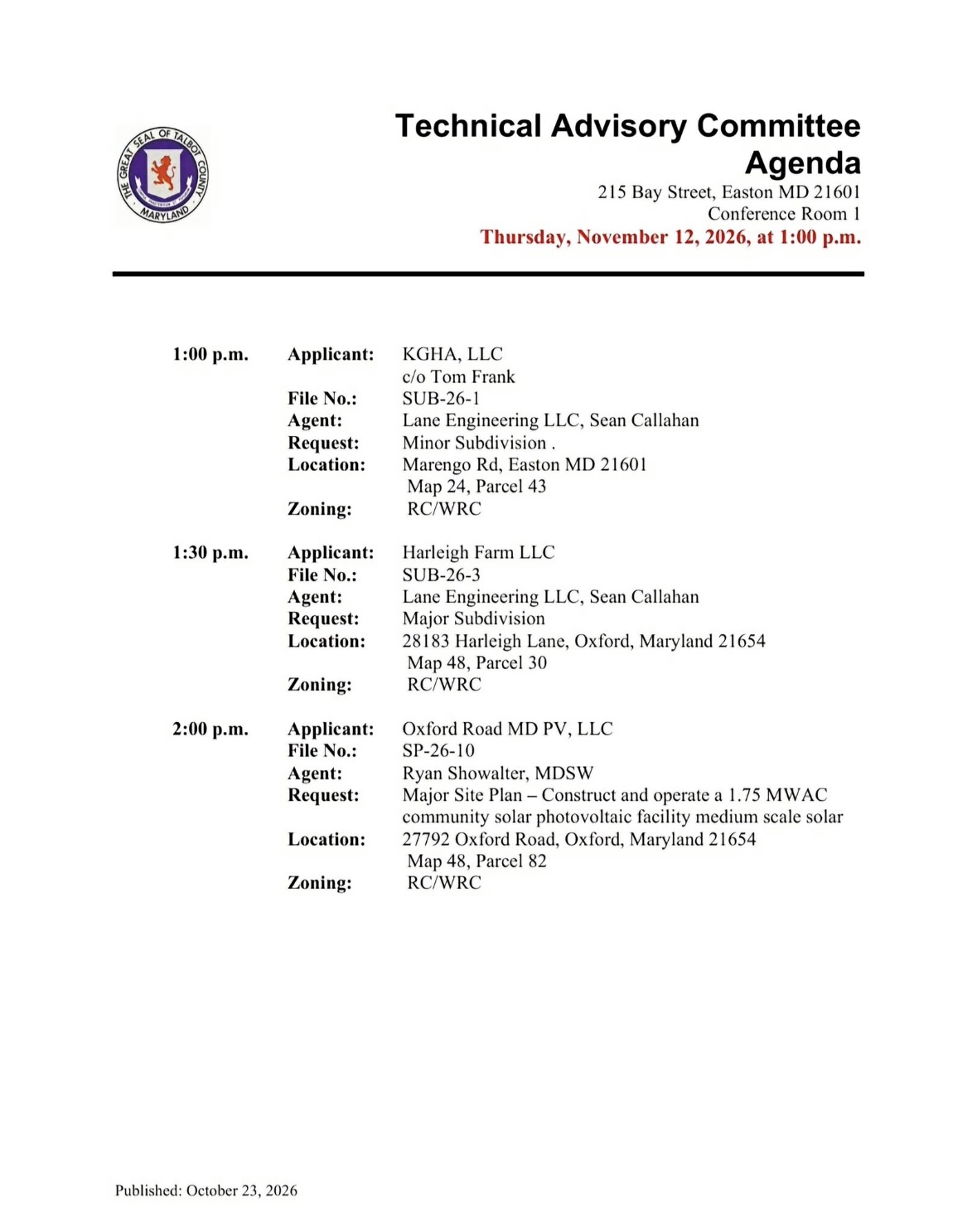
County staff reviewed the application at the Technical Advisory Committee on November 12, 2026; the Planning Commission hearing comes next. Written comments can go to the Talbot County Department of Planning and Zoning, 215 Bay Street, Suite 2, Easton, MD 21601 (410-770-8030). Comments are most useful when they ask for something specific, such as side screening along Oxford Road or a recycling commitment in the decommissioning plan.
• Renewable Energy Certainty Act (SB 931/HB 1036), fiscal and policy note
• Talbot County solar zoning summary, DNR Power Plant Research Program
• Talbot County TAC agenda, November 12, 2026
• Critical Area Commission solar regulations FAQ
• USDA 2022 Census of Agriculture, Talbot County profile
• NC State summary of NC DEQ solar decommissioning study
• Barron-Gafford interview on the solar heat island
• Fthenakis and Yu, heat island analysis of a large solar farm
• pv magazine on LBNL and Ball State property value studies
• Maryland PSC small generator interconnection workgroup report
• Maryland PSC community solar program
• SOLARCYCLE on Maryland end-of-life policy
• FERC guide to natural gas facilities and rights-of-way
• Great River Energy, typical transmission structure heights and rights-of-way
• HB 908 (2023), Chapter 652, community solar permanent program
• Maryland PSC, Community Solar Program
• Maryland PSC, Community Solar Program FAQ
• Solstice, Maryland community solar policy summary
• MDE Stormwater Design Guidance – Solar Panel Installations
• Chesapeake Bay Program STAC, PV-SMaRT best practices
• Vienna Generating Station (Wikipedia)
• PPRP fact sheet, Vienna to Nelson transmission rebuild (PSC Case 9698)
• COMAR 20.50.09.06, small generator interconnection general requirements
• Maryland PSC Order No. 89933 on smart inverters
• PJM study of a Delmarva distribution-level solar interconnection (AB2-167)
Opinion and Contributor Content Disclaimer
From time to time, this publication publishes opinion pieces, guest columns, letters, and articles submitted by individuals and organizations outside of our editorial staff. The views, opinions, and assertions expressed in such contributions are solely those of the authors and do not necessarily reflect the views, policies, positions, or opinions of this publication, its editors, owners, staff, or affiliates.
Publication of outside submissions does not constitute endorsement of any statements, claims, conclusions, products, services, or organizations referenced therein. Responsibility for the accuracy of facts, opinions, and representations contained in contributed content rests entirely with the author(s).