Oxford Town Manager Holly Wahl Shares Insights About Her First Year On The Job
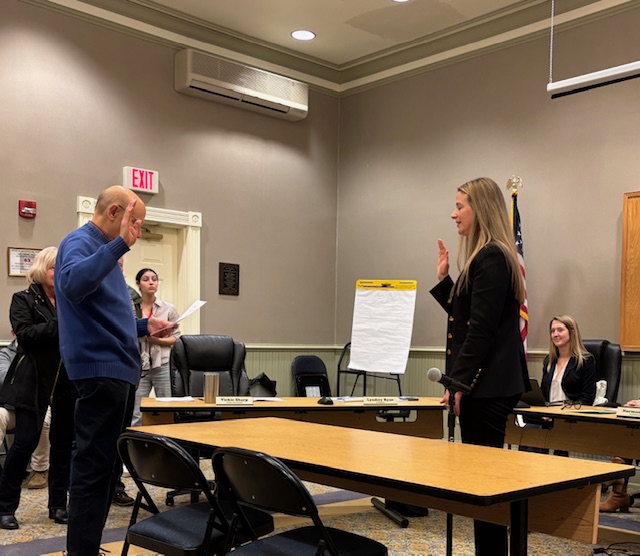
Above: Holly Wahl was sworn in as Oxford Town Manager in January, 2025.
Anyone who has lived in Oxford, Maryland for the past three years (or longer) might wonder why anyone would EVER take on the job of Town Manager there. After all, the allegations of financial mismanagement leading to a huge deficit in town funds, the lack of oversight of a 2 million dollar plus Strand "Restoration" Project which has negatively transformed the Town's once beautiful beach forever, a looming tidal and stormwater disaster, and the upheaval over allegations of favors given to some citizens over others are just part of the story of Oxford during that time.
Please Follow us on Gab, Minds, Telegram, Rumble, Truth Social, Gettr, Twitter, Youtube
So, when the Commissioners of Oxford, through a national hiring firm, hired Holly Wahl, former manager of Chesapeake Beach for the position, people were amazed that a person with such great credentials would take the job.
Wahl came from Chesapeake Beach, Maryland where she spent eight years as the town's administrator. Chesapeake Beach is a town of approximately 6500 residents in southern Maryland. She currently lives with her husband near Wye Mills and has two adult sons and three dogs. Here is a link to her bio and qualifications from the town's website:
Oxford Town Administration | Oxford, MD
It's been almost a year since Ms. Wahl came to Oxford, so we thought it was time to interview her for the Easton Gazette. Our first question was why she would take the job.
When we asked, Holly gave a clear and direct answer. "When I reviewed the challenges occurring within the town, I saw the impact my skillset, experience and education could make."
Plus, she said, she was impressed both by the beauty of the town and the way the commissioners conducted her interview. "They took me to see everything, the water treatment plant, the Strand, and just about every part of town."
Wahl also found Oxford to be very similar to the previous city she worked for, Chesapeake Beach in Calvert County. That similarity doesn't mean the job has been easy. Wahl found that Oxford needed consistent practices and processes to get the town's work done in order to protect the town and all residents. She needed to make sure that staff understood how to channel information to boards, commissions and the public. The biggest challenge was to get the budget restructured, make sure the town had reserves and there was a full, detailed accounting of how public money is spent.
Many residents of the town comment that, after years of muddy financial record keeping and administrative secrecy, the transparency is refreshing. This is extremely important, particularly with enterprise fund accounting methods. Oxford operates under its municipal charter and the Local Government Article of the Annotated Code of Maryland. These require that enterprise funds (business-type activities) be accounted for separately from governmental funds. This had not been done during the previous administration's tenure.
And then there is the very important issue of making sure that the town has reserves set aside to protect the town in case of an emergency. Currently, the town is addressing that issue while it deals with a deficit left by years of overspending.
Many people might be stymied by all of this, but in Wahl's opinion, all of this is an opportunity to give everything a "fresh look."
This also means getting good people in the right places and educating town committees on their function and how they should operate, streamlining processes, and making sure that town operations are consistent with legislation.
That last task brings one of the biggest changes. While Oxford and all towns in Talbot County have the authority to issue permits, there are processes and reviews which must be followed. In the past, the permitting process seemed inconsistent depending on who was applying for a permit. For example, from around 2012 through 2023, there were homes built and renovated in Oxford which allegedly never went through a single committee approval because of who the designer or architect was. Others were stalled by the town office for "unknown" reasons. Some of the homes were allowed lot coverages that violated the town code while others were required to maintain strict compliance.
Now, when a permit is applied for, the town makes sure all the reviews have been done prior to issuing a permit: zoning overview, technical review, floodplain review, stormwater review, State Critical Area Commission reviews, Talbot County Soil Conservation District review, town engineer review (if necessary), public works review(if necessary), Planning Commission Review, Historic District Review, Building Inspector Review, and finally, a Conditions Letter Development which assembles the final conditions letter for the project (if approved). If you counted, that's twelve. Twelve checks that sometimes take a long time.
Clerk for Planning and Permitting Ashley Samonisky handles all of these permits and reviews. When we visited her office during Wahl's interview, Samonisky showed us a pile of pending permits and reviews that was 3 inches high.
This was not the process followed previously and some in the town are confused by the change. They think the town is requiring more work when, in reality, this work HAS to be completed due to either Federal, State, County or Town codes and laws. It's vital in order to protect the town, its residents, critical infrastructure, and waterways from the impacts of development.
It should have been a process that was always followed.
It does mean a great deal of work for the staff of the town office, which currently stands at three, the Town Manager, the Town Planner, and a receptionist. The town also employs the services of a part time CPA.
On top of all that work, the staff handles questions, concerns and all other town business that makes it way to the town office. In a small town like Oxford, citizens are more inclined to call the town office for remedies for problems and answers to questions. According to Wahl and Samonisky, dealing with these issues can take anywhere from 50% to 75% of the workday making for a long day, particularly when the day includes various commissioner and committee meetings along with the two town meetings a month on the second and fourth Tuesdays.
All while Wahl and her staff maintain a calm, professional and positive demeanor.
Imagine staying calm and focused when the local post office had a fire which did severe damage to the building, which is owned by the town.
The fire caused a huge problem for Oxford, as residents of the town who live in the historic district rely on P.O. boxes in the Post Office for their mail. Not only that, but for some reason, the previous town administration had never put either of the buildings on Oxford's list of insured assets. This could have meant that the town would have to assume the total cost of the restoration of the post office. Luckily, that situation was quickly remedied by Wahl and the insurance provider.
Imagine addressing the difficulty of dealing with a federal agency when it comes to restoring an office they must use and administer? Not easy. But, Wahl and her staff are making progress on that problem along with several others.
It's just one of those challenges that Wahl gladly welcomes.
In her opinion, it's all worth it. When describing the Town of Oxford and its citizens, Wahl said the town has a long history of "adaptability, community spirit, connections and watching out for each other." She also described residents as "invested" in their town.
"They are open to exploring new ideas and points of view so long as reasoning is clear and transparent. They bring excellent and diverse skillsets to the town that we need for better decision making."
Wahl is also mindful that the number of residents who have second homes in Oxford is growing. Since Oxford sits on the banks of the beautiful Tred Avon River, it attracts many retirees and those who wish to own a quiet, scenic place to spend their summers and vacations.
The prevalence of part time residents (approximately 40-45% of the town's current residents) brings positive and negative aspects. Recently, it has raised questions about whether part time residents should be able to vote in town elections. Any changes in voting eligibility have been tabled by the Commissioners.
The U.S. Census numbers for the town can be impacted negatively when a majority of residents don't claim Oxford as their full-time home. The Census Bureau itself emphasizes that the results “shape how hundreds of millions of dollars in federal funding are distributed across the country—for business development, rural education, and much more”.
For a small town, even a few hundred residents being undercounted can mean losing out on significant funding for an entire decade. It is also notable that a high second home population creates a high level of unpredictability for the purposes of managing critical infrastructure. For example, the Oxford treatment plant is permitted by average daily flow, and staff monitors and adjusts set points at the plant for an expected usage. Those adjustments are required to stay within our permitted levels at the plant. When there is such a large percentage of non-primary occupied dwellings in town it can be difficult to make predictions about those set points. A lack of predictability can have implications on the Towns permits due to a lack of consistency.
The Census Bureau acknowledges and explains how the Census affects small towns: Our Rural Communities This presents a unique challenge to the town to maintain the town's funding and vitality.
But again, Wahl likes challenges. In her second year, she hopes to assure stability, predictability, and fairness for all residents via transparency, access to information, and better decision making. She also wants to promote participatory budgeting for stormwater, flooding issues, and critical infrastructure via revenue streams and services to ensure the town is most efficient with funds so services can be provided to all residents. This may include partnerships with Talbot County, the Sheriff's office, and other municipalities local to Oxford.
While writing this story, we found this quote about challenges:
"Challenges are what make life interesting. Overcoming them is what makes life meaningful." -Joshua J. Marine, author and lecturer.
This seems like a quote that Holly Wahl would post in her office!
*According to records on file, the post office building ownership was transferred to the town on December 29,2023 along with the building that previously housed Bay Vanguard Bank. That transfer of ownership was from the Oxford Fire Company, although that ownership cannot be confirmed via state or local records. The transfer was made just months before the departure of the previous town manager, Cheryl Lewis.